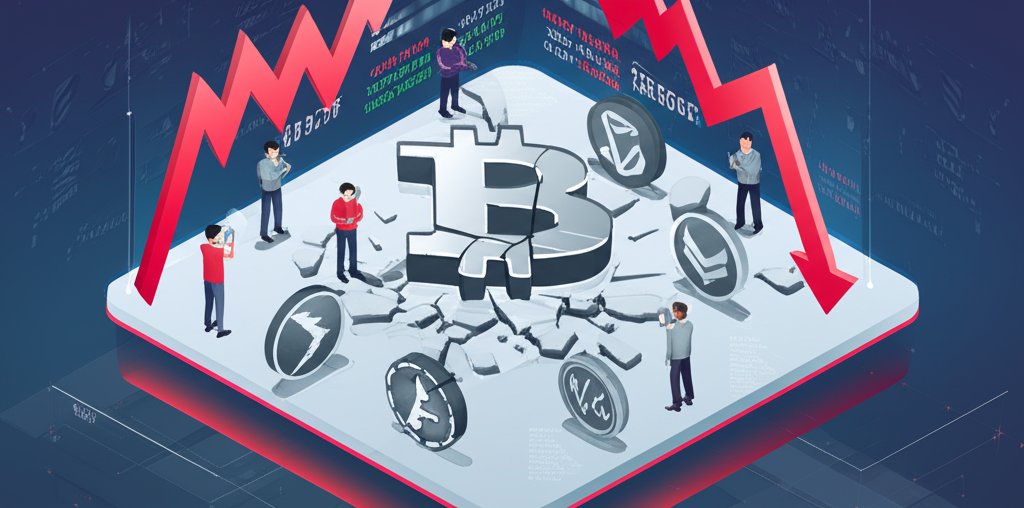
The sharpest lesson in leveraged crypto trading often comes not from profit, but from a total liquidation. It’s the abrupt, unavoidable closing of your entire position by the exchange when your margin balance dips below a critical threshold. You don't get a second chance, a partial close, or a gentle nudge—your trade is simply wiped out, and often, so is your initial capital. This isn't just a technical event; it's a stark, often painful, reminder of the unforgiving nature of high leverage in volatile markets.
At a Glance: What You'll Master Here
- Deconstruct Total Liquidation: Understand the precise triggers and mechanics that lead to your entire position being closed.
- Spot the Warning Signs: Learn to identify market conditions and trading habits that pave the way for a wipeout.
- Leverage Liquidation Data: Discover how to use tools like liquidation heatmaps to anticipate market movements and protect your capital.
- Formulate Protective Strategies: Implement actionable steps to mitigate liquidation risk and optimize your stop-loss placements.
- Beyond "Rekt": Grasp the real impact and how to build resilience in your trading approach.
The Unforgiving Mechanics: When Your Margin Hits Empty
In the high-stakes arena of crypto derivatives, you're trading with borrowed capital, or leverage. This amplifies both potential gains and losses. Exchanges require you to put up a small percentage of the total trade value as "initial margin." Once your trade is open, they also enforce a "maintenance margin"—a minimum equity percentage you must maintain in your account to keep the position alive.
A total liquidation occurs when unfavorable price movements cause your position's value to drop so significantly that your account equity falls below this maintenance margin. At that point, the exchange's automated system steps in. It swiftly closes your entire leveraged position to prevent your losses from accumulating further and to protect the exchange from potential bad debt. There’s no negotiation; the system executes. This mechanism is crucial for the stability of the entire derivatives market, yet it's often the bane of individual traders.
To truly grasp the foundational concepts of how these mechanisms operate within the broader context of derivatives, it's helpful to Understand Crypto Liquidations more deeply. This will provide a solid framework for the specifics we're discussing here.
The Cascade Effect: How a Single Wipeout Can Trigger Many
Total liquidations rarely happen in isolation, especially in highly leveraged markets. When an exchange closes a large position, it often involves selling off the underlying assets to cover the margin call. This forced selling can add downward pressure on the price (for long positions) or upward pressure (for short positions). If many traders are positioned on the same side with similar leverage levels, a sudden price swing can trigger a chain reaction.
Imagine a domino effect: one liquidation pushes the price slightly, which triggers another trader's maintenance margin, forcing their position to close, which pushes the price further, and so on. This "liquidation cascade" or "short squeeze" (if shorts are liquidated) can accelerate price movements dramatically, creating rapid, volatile swings that catch many traders off guard and lead to widespread "rekt" events—the crypto slang for being utterly ruined by a liquidation.
Deciphering the Signs: What Leads to a Total Liquidation?
While market volatility is often the proximate cause, several underlying factors significantly increase the risk of total liquidation:
- Excessive Leverage: This is the primary culprit. Trading with 50x or 100x leverage means even a 1-2% adverse price move can wipe out your initial margin. The higher your leverage, the closer your liquidation price is to your entry price.
- Poor Risk Management: Failing to use stop-loss orders, or placing them too close to your entry, leaves you exposed. Not understanding your exact liquidation price is another critical oversight.
- Ignoring Funding Rates: In perpetual futures, positive or negative funding rates can slowly erode your margin over time, especially if you're holding a position for an extended period against the prevailing sentiment.
- Trading Against Extreme Market Sentiment: Going long during a clear downtrend or short during a strong uptrend with high leverage is akin to swimming against a strong current—eventually, you'll be dragged under.
- Insufficient Margin Balance: Even if your current position isn't at risk, having a low overall account balance means there's less buffer to absorb losses across multiple trades or during unexpected market spikes.
- News Events & Black Swan Incidents: Geopolitical events, major exchange hacks, regulatory crackdowns, or sudden celebrity endorsements can trigger massive, unpredictable price movements that even well-managed positions struggle to withstand.
Case Snippet: The "Long Squeeze" Event
In May 2021, Bitcoin saw a massive capitulation. Many traders were heavily long with high leverage, expecting continued upward momentum. When key support levels broke, a wave of liquidations (specifically, long positions) triggered more selling pressure. This cascade accelerated the price drop, leading to hundreds of millions, if not billions, in total liquidations across major exchanges, turning bullish bets into immediate, total losses.
Liquidation Heatmaps: Your Crystal Ball for Market Stress
Liquidation heatmaps are powerful visual tools that show where clusters of leveraged positions are most vulnerable to being liquidated. Think of them as X-rays of market stress, highlighting price levels where significant numbers of long or short positions are poised for a wipeout. Platforms like CoinGlass aggregate this data across major exchanges (Binance, Bybit, Bitget, etc.).
- Red Zones: Indicate areas where significant short positions would be liquidated if the price rises to that level. A strong move into a red zone can trigger a "short squeeze," accelerating the price upward as shorts are forced to buy back.
- Green Zones: Highlight areas where substantial long positions would be liquidated if the price drops to that level. Breaking into a green zone can initiate a "long squeeze" or cascade, pushing the price lower as longs are forced to sell.
- Color Intensity: Darker shades of red or green signify larger volumes of capital at risk at those specific price points, indicating more extreme market sentiment and potential volatility hotspots.
How to Interpret:
If you see a large, dark green zone just below the current price, it means a lot of leveraged long positions are vulnerable there. A slight downward push could trigger those liquidations, potentially sending the price even lower as forced selling kicks in. Conversely, a dark red zone above the current price suggests a potential target for a squeeze if the price starts moving up.
Strategic Applications of Liquidation Data
Understanding where total liquidations are clustered isn't just for curiosity; it's a vital component of advanced trading strategies:
- Identifying Potential Entry & Exit Zones: High-liquidation zones often act as magnets or resistance levels.
- For entries: If you're looking to go long, observing strong green liquidation zones significantly below current price might suggest potential support if the price drops, but also a potential cascade point to be wary of. Conversely, a large red zone above could indicate a profit target for a long, or a good short entry if the squeeze fails.
- For exits: If you're long and price approaches a large green zone below your entry, it's a critical area. If it breaks, a cascade could follow. For shorts, watching red zones above is key.
- Predicting Market Sentiment Reversals: Large-scale liquidations often coincide with emotional extremes in the market. A sudden spike in long liquidations after a strong uptrend can signal buyer exhaustion and a potential reversal downwards. Conversely, a massive short squeeze might indicate a bottom is forming.
- Optimizing Stop-Loss Placement: Placing your stop-loss order directly within a heavy liquidation zone is often a recipe for premature closure.
- The Smart Move: Set your stop-loss just outside these high-liquidation clusters. If the market is indeed targeting these zones for a cascade, you want to be out before the main event, not caught in the initial trigger. For instance, if a massive long liquidation zone is at $40,000, consider placing your stop at $39,950 rather than $40,050 if you are long.
- Identifying Overheated Markets: A build-up of massive, concentrated liquidation zones around a specific token (e.g., a newly trending altcoin) suggests excessive speculative leverage. This is a clear warning to adjust position size, reduce leverage, or even avoid the asset until sentiment normalizes.
Beyond the Heatmap: Combining Indicators for Higher Accuracy
While liquidation heatmaps offer invaluable insights, they are most effective when used in conjunction with other metrics:
- Funding Rates: High positive funding rates (longs paying shorts) combined with significant green liquidation zones below the current price can signal an overleveraged long market ripe for a pullback and cascade. Negative funding rates (shorts paying longs) with large red zones above can signal a potential short squeeze.
- RSI Heatmaps: These visualize areas of potential overbought/oversold conditions. Combining an overbought RSI (on a heatmap) with high green liquidation zones can strengthen a bearish reversal signal.
- Long/Short Ratio: This ratio indicates the overall sentiment. If the ratio is heavily skewed to long positions, and you see substantial green liquidation zones below, it corroborates the idea that a significant price drop could trigger widespread liquidations.
- On-Chain Data: Looking at exchange inflows/outflows, whale movements, or stablecoin dominance can add another layer of conviction to your liquidation-based analyses.
Practical Scenario: Using Combined Indicators
You observe Bitcoin with a highly positive funding rate (many longs paying shorts), a strong Long/Short ratio favoring longs, and a prominent dark green liquidation heatmap zone at $42,000. Price is currently at $43,500. This confluence suggests an overleveraged long market. If price starts dipping towards $42,000, the probability of a cascade and subsequent total liquidations for many long positions increases significantly. This information would guide you to either tighten your long stop-loss, consider a short position, or simply stay on the sidelines.
The Human Element: When "Rekt" Becomes a Reality
"Rekt," a colloquialism derived from "wrecked," is a term that resonates deeply within the crypto community. It's not just about losing money; it describes the devastating feeling of having your financial position obliterated due to market movements or poor decisions. It’s a painful reminder of the market's power and the risks of leverage.
Experiencing a total liquidation can be a significant psychological blow. It often leads to:
- Emotional Trading: Trying to "get back" what was lost, leading to even riskier trades.
- Loss of Confidence: Doubting one's trading ability, which can paralyze future decisions.
- Burnout: Stepping away from trading entirely due to the stress.
Acknowledging the emotional impact is part of developing resilience. Every experienced trader has likely been rekt at some point. The key is to learn from it, adapt, and build stronger risk management habits.
Your Playbook to Mitigate Total Liquidation Risk
Proactive measures are your best defense against having your trades completely wiped out. Here’s a practical playbook:
- Understand Your Liquidation Price: Before entering any leveraged trade, calculate your exact liquidation price. Many exchanges show this automatically. If not, use a liquidation calculator. Know your "point of no return."
- Define Your Max Risk Per Trade: Never risk more than 1-2% of your total trading capital on a single trade. This means adjusting your position size and leverage so that if your stop-loss is hit, you only lose a small, manageable percentage.
- Always Use a Stop-Loss: This is non-negotiable. Place your stop-loss at a logical technical level that invalidates your trade idea, and ensure it's outside of obvious high-liquidation zones.
- Practice Smart Leverage: Resist the temptation of extremely high leverage (50x, 100x) unless you are an extremely experienced short-term scalper. For most traders, 3x-10x leverage offers a better balance of profit potential and risk control.
- Maintain Adequate Margin Buffer: Don't trade with an account balance that's barely above your margin requirements. Keep a healthy buffer to absorb volatility without immediately facing liquidation.
- Diversify (Within Reason): Don't put all your eggs in one highly leveraged basket. Spreading risk across different, uncorrelated assets can help.
- Regularly Review Market Liquidation Data: Make it a habit to check liquidation heatmaps before entering significant positions, and keep an eye on them during volatile periods. Adapt your strategy based on what the data suggests about market vulnerabilities.
- Mind Your Psychology: Don't let fear of missing out (FOMO) or revenge trading dictate your decisions. Stick to your trading plan and risk management rules, especially after a loss.
Quick Questions & Clear Answers:
Q: Can I prevent a total liquidation once the price is near my liquidation point?
A: Your best bet is to add more collateral to your margin account (often called a "margin top-up") before the price hits the liquidation level. This will shift your liquidation price further away from the current market price, giving your trade more breathing room. However, this is essentially doubling down on a losing trade, which can be very risky.
Q: How quickly can a total liquidation happen?
A: Instantly. The moment your margin balance drops below the maintenance margin, the exchange's automated system triggers the close. In highly volatile markets, this can happen in a matter of seconds.
Q: Is "total liquidation" different from "partial liquidation"?
A: Yes, though the focus here is on total. A partial liquidation might occur on some exchanges or for certain positions where only a portion of your position is closed to bring your margin back above the maintenance level. A total liquidation, as discussed, closes the entire position, wiping out the initial collateral. It’s the full wipeout.
Q: If I get totally liquidated, do I owe the exchange money?
A: Typically, no. Most modern crypto exchanges employ an "auto-deleveraging" (ADL) system or an insurance fund to cover shortfalls from liquidations. This means your losses are capped at your initial margin and any additional collateral in that specific position. However, it's crucial to understand the specific terms of the exchange you're using.
Building Resilience: The Path Forward
Total liquidations are an inevitable part of leveraged trading for many participants. However, they don't have to be career-enders. By understanding the underlying mechanics, vigilantly monitoring market indicators like liquidation heatmaps, and rigorously applying sound risk management principles, you can drastically reduce your exposure. The goal isn't just to make profit; it's to survive the inevitable market storms. Treat every trade as a calculated risk, prioritize capital preservation, and let data, not emotion, guide your decisions. This approach will not only help you avoid being "rekt" but also position you for sustainable growth in the dynamic world of crypto.