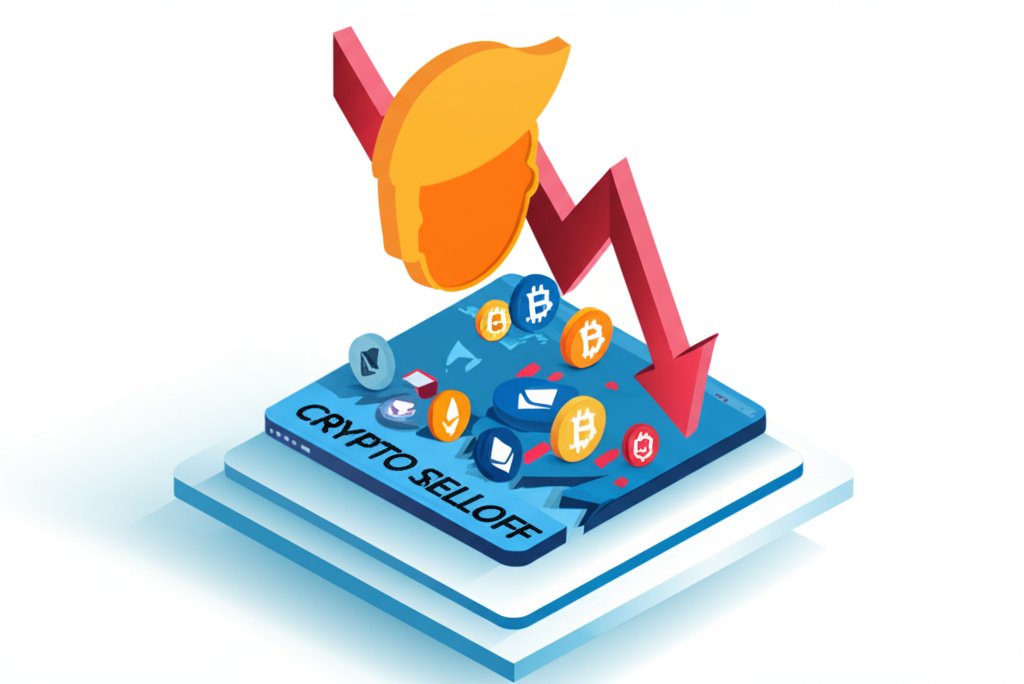
The digital asset landscape, often celebrated for its independence, recently felt the tremors of global geopolitics when a sudden threat from former President Donald Trump sparked a swift crypto selloff. This wasn't just a minor correction; it was a stark reminder of how interconnected our markets truly are, triggering a cascade of liquidations and significant losses across the board. Understanding the mechanics of such an event is crucial for anyone navigating the volatile world of cryptocurrencies.
At a Glance: Navigating a Geopolitical Crypto Selloff

- Understand Catalysts: Recognize how macro-economic and geopolitical threats (like tariffs) can directly trigger market-wide "risk-off" sentiment.
- Leverage Amplifies Risk: Learn how high leverage can turn a market dip into a flash crash, leading to forced liquidations and magnified losses.
- Flight to Safety: Observe the market’s predictable shift from risk assets (crypto, tech stocks) to safe havens (gold, silver) during uncertainty.
- Beyond the Headlines: Identify secondary factors like technical glitches and market speculation that can exacerbate a selloff.
- Post-Selloff Strategies: Discover actionable steps for managing risk, rebalancing portfolios, and preparing for future volatility.
- Long-Term Resilience: Distinguish between short-term market noise and long-term structural strengths supporting crypto adoption.
When Geopolitics Hits Hard: The Trump Tariff Trigger

The catalyst for this particular crypto selloff was immediate and dramatic: an unexpected declaration by former President Donald Trump threatening new tariffs on Chinese imports. This wasn't just political saber-rattling; it ignited a deep-seated fear in financial markets globally. Tariffs signal trade wars, which can stifle economic growth, raise costs for consumers, and squeeze corporate profits. In an instant, risk appetites evaporated.
Investors, sensing economic headwinds, rapidly shifted capital away from assets perceived as risky – and that unequivocally includes cryptocurrencies and technology stocks. The result was a classic "risk-off" scenario, leading to widespread selling pressure that hit digital assets particularly hard. As we observed in the immediate aftermath, traditional markets also reacted sharply, with the Nasdaq Composite dropping 3.56% and the S&P 500 experiencing its worst day since April. This interconnectedness underscores that crypto, while a distinct asset class, is not immune to the broader macroeconomic currents. For a deeper dive into how tariffs, specifically, can disrupt markets and fuel significant digital asset losses, you can explore how Trump tariffs fueled crypto losses.
The Avalanche Effect: How Leverage Turns a Dip into a Deluge
What transformed a significant market downturn into a flash crash of unprecedented scale was the pervasive use of high leverage in the crypto ecosystem. Many traders, eager to amplify their potential gains, borrow funds to increase their position sizes. While this can magnify profits in a rising market, it catastrophically amplifies losses when prices move against them.
During the selloff, as Bitcoin plummeted 15% from around $122,500 to a low of $104,600, and Ethereum plunged 21%, a brutal mechanism kicked in: margin calls and forced liquidations. When a leveraged position loses too much value, exchanges automatically close these positions to prevent further losses for the lender. According to CoinGlass data, this mini-crash resulted in a staggering $19 billion in liquidated positions, impacting approximately 1.6 million traders. Samir Kerbage, CIO at Hashdex, accurately described it as a "textbook example of how leverage can amplify short-term volatility." This isn't just about individual losses; the sheer volume of these forced sales creates a downward spiral, pushing prices even lower as more positions are automatically closed, further intensifying the crypto selloff.
Understanding Leverage and Liquidation
Imagine you want to buy $1,000 worth of Bitcoin, but only have $100. A platform offers you 10x leverage, allowing you to control $1,000 with your $100.
- Profit Scenario: If Bitcoin rises 10%, your $1,000 position is now worth $1,100. You've made $100 profit on your initial $100, effectively doubling your money (minus fees).
- Loss Scenario (The Selloff): If Bitcoin drops 10%, your $1,000 position is now worth $900. Your initial $100 capital is gone. The exchange will automatically "liquidate" your position – sell your Bitcoin – to recover the borrowed funds. This forced selling adds to market pressure.
- Margin Call: Sometimes, before full liquidation, the exchange might issue a "margin call," asking you to deposit more funds to cover potential losses. If you don't, liquidation follows.
This cascading effect explains why Dogecoin dropped more than 50% and even the politically themed $TRUMP coin plunged around 63% during this period. Highly speculative assets, often traded with even higher leverage, bore the brunt of the market's contraction.
Beyond Tariffs: Other Contributing Factors to the Downturn
While Trump’s tariff threat was the primary trigger, other undercurrents contributed to the volatility and anxiety during the crypto selloff. In complex market events, it's rarely a single cause.
The Binance Stablecoin Glitch
Technical concerns can rattle market confidence, even briefly. During the selloff, a stablecoin on the Binance exchange momentarily lost its 1:1 peg to the US dollar. Stablecoins are foundational to crypto trading, offering a stable haven amidst volatility, so any deviation, however brief, sends ripples of unease. Binance quickly attributed it to a "brief technical glitch" and restored the peg, but in a highly stressed market, such incidents can amplify panic and add to the selling pressure as traders question even the most reliable assets.
Social Media Speculation
In the digital age, social media acts as a rapid firehose of information, and misinformation. During the selloff, rumors and speculation about potential insider trading circulated widely. The idea that some traders might have had advance knowledge and profited from the falling market, while difficult to prove, fueled distrust and emotional responses. This added another layer of uncertainty, contributing to the "fear, uncertainty, and doubt" (FUD) that often accompanies significant market corrections.
Navigating the Aftermath: Stabilisation and Long-Term View
Amidst the chaos of the flash crash, markets eventually showed signs of stabilization. By the following Monday, Bitcoin had recovered to around $115,000, a partial rebound but still below its record high of over $126,000 achieved just days earlier. This period after a sharp selloff is critical for investors to assess the damage, understand the broader context, and strategize for the future.
The Role of Safe Havens
During the selloff, while risky assets plummeted, traditional safe havens soared. Silver futures, for instance, jumped 7% to a new record high. This flight to tangible, historically stable assets like precious metals is a classic indicator of market participants seeking refuge from uncertainty. It highlights a fundamental principle of investing: diversification, not just within crypto, but across asset classes, can be a crucial buffer during times of extreme stress.
Structural Strengths vs. Short-Term Volatility
Despite the dramatic short-term volatility, experts like Samir Kerbage point to the "structural strengths" that continue to support crypto's long-term growth. The ongoing adoption of Bitcoin ETFs (Exchange-Traded Funds) and increasing regulatory clarity are examples of fundamental developments that build institutional confidence and pave the way for wider mainstream acceptance. These factors, while not immune to geopolitical shocks, provide a robust backdrop that suggests temporary selloffs, while painful, do not necessarily signal the end of the market's upward trajectory. It’s about differentiating between momentary market noise and underlying value propositions.
Practical Playbook: Your Guide to Future Volatility
A severe crypto selloff like the one triggered by tariff threats offers valuable lessons. Here's a practical playbook for managing risk and positioning yourself for the long term.
1. Master Risk Management, Especially with Leverage
- Understand Your Exposure: Before entering any leveraged position, fully grasp the liquidation price and potential maximum loss. Tools on exchanges can simulate these scenarios.
- Start Small: If you're new to leverage, use minimal amounts (e.g., 2x or 3x) to understand the dynamics before considering higher multiples.
- Set Stop-Loss Orders: Always place stop-loss orders to automatically close your position if the price hits a predetermined threshold. This caps your potential loss, preventing total liquidation during a flash crash.
- Avoid Over-Leveraging: As tempting as it is, avoid using the maximum leverage offered. A smaller drop can wipe out your entire capital with high leverage.
- Monitor Liquidation Prices: Keep a close eye on your positions' liquidation prices. If the market is nearing them, consider adding collateral (topping up your margin) or reducing your position size.
2. Diversification: Beyond Just Different Coins
- Asset Class Diversification: Don't put all your eggs in the crypto basket. Consider a balanced portfolio that includes traditional assets like equities, bonds, and even precious metals (as seen with silver's performance).
- Stablecoin Strategy: During extreme volatility, having a portion of your portfolio in stablecoins can offer a temporary safe haven within the crypto ecosystem, allowing you to re-enter the market after the dust settles.
- Geographic Diversification (Indirect): Look for projects and protocols that have global reach and are not overly reliant on a single regulatory or economic environment.
3. Emotional Discipline: The Hardest Skill
- Develop a Plan: Before a selloff occurs, define your entry and exit strategies, your risk tolerance, and your long-term goals. Stick to it.
- Avoid Impulse Decisions: Panic selling often locks in losses that could have recovered. Similarly, "catching a falling knife" (buying too early into a steep drop) can be dangerous.
- Step Away: Sometimes, the best action is no action. If emotions are running high, take a break from monitoring charts and social media.
- Focus on Fundamentals: Remind yourself of the long-term potential of the projects you've invested in. Short-term price action often disconnects from fundamental value.
4. Rebalancing Your Portfolio Post-Selloff
- Assess Impact: After the initial shock, evaluate which assets were hit hardest and which held up relatively well.
- Revisit Your Allocation: If certain assets now represent a much smaller (or larger) percentage of your portfolio than your target allocation, consider rebalancing. This might mean buying more of the assets that dropped significantly (if their long-term thesis remains strong) or trimming positions that performed unexpectedly well.
- "Buy the Dip" with Caution: While a selloff presents buying opportunities, approach with caution. Don't go all-in immediately. Consider dollar-cost averaging (buying small amounts regularly) to mitigate the risk of buying too early.
Quick Answers: Common Questions on Crypto Selloffs
Q: Is crypto inherently more volatile than traditional assets?
A: Generally, yes. Crypto markets are smaller, less liquid, and often more susceptible to sentiment, news, and technical factors. This leads to higher price swings compared to established asset classes like stocks or bonds, especially during events like a crypto selloff.
Q: How can I protect myself from flash crashes like this?
A: Diversify your portfolio across different asset classes, not just within crypto. Use stop-loss orders diligently, especially on leveraged positions. Keep a portion of your capital in stablecoins or fiat for potential buying opportunities or as a defensive measure. Most importantly, avoid over-leveraging.
Q: What role do stablecoins play in a selloff?
A: Stablecoins are designed to maintain a fixed value, typically pegged to the US dollar. During a selloff, they act as a temporary refuge for capital within the crypto ecosystem. Traders can move funds into stablecoins to avoid further losses from volatile assets, then re-deploy them when market conditions stabilize. However, even stablecoins can briefly de-peg due to technical issues, as seen with Binance, so they aren't entirely without risk.
Q: Are geopolitical events like tariffs always a trigger for a crypto selloff?
A: Not always, but they are common catalysts. Geopolitical tensions, economic policy changes, and major regulatory announcements often lead to "risk-off" sentiment in global markets. Since cryptocurrencies are largely considered risk assets, they tend to be sold off alongside tech stocks and other speculative investments during such periods. The magnitude of the selloff often depends on the severity of the event and the prevailing market sentiment.
Staying Resilient in Volatile Markets
The crypto selloff triggered by Trump’s tariff threat served as a powerful reminder of how external forces can impact even the most independent-minded markets. While the immediate pain of liquidations and price drops was significant, the market's eventual stabilization and the underlying structural strengths offer a nuanced perspective. For investors, this event wasn't just a loss but a masterclass in market dynamics: the amplifying power of leverage, the flight to safety, and the critical importance of robust risk management. As the crypto market continues to mature, understanding these lessons will be paramount to building resilience and navigating the inevitable future shocks with greater confidence.