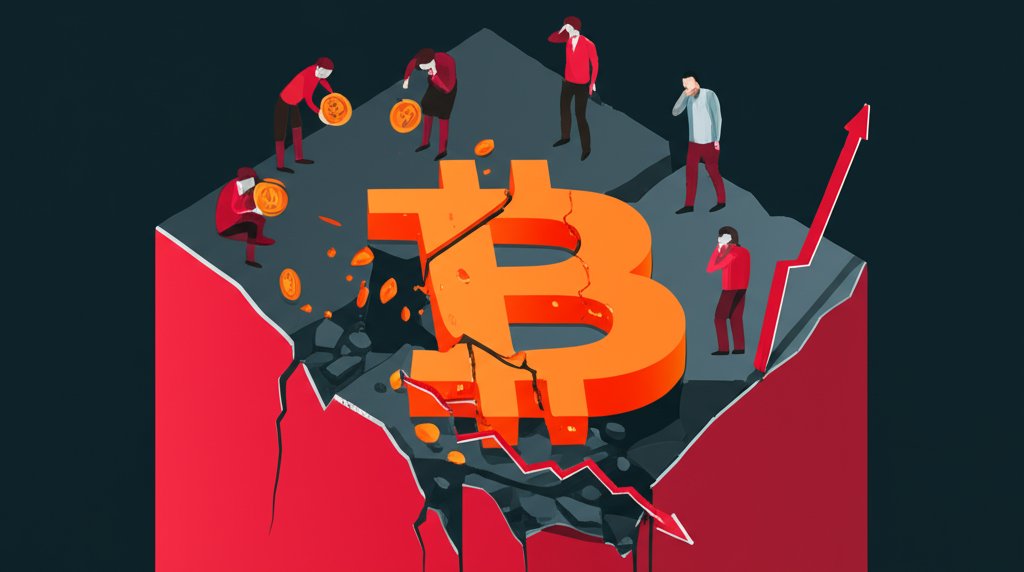
When the former U.S. President Donald Trump announced his plans for imposing hefty tariffs on Chinese goods, particularly targeting key industrial and strategic materials, the cryptocurrency market braced for impact. True to form, bitcoin plunges swiftly followed, reflecting a palpable shift in investor sentiment from risk-on to risk-off. This isn't just a routine market fluctuation; it's a direct consequence of escalating global trade tensions creating widespread anxiety and a scramble for safer assets.
Navigating such sudden downturns requires more than just watching charts. It demands a deep understanding of the underlying macroeconomic drivers and a practical approach to managing your crypto holdings.
At a Glance
- Tariffs Trigger Risk Aversion: Learn how Trump's proposed tariffs on Chinese goods directly cause capital flight from volatile assets like Bitcoin.
- Key Support Levels to Watch: Understand the critical $116,000 to $118,000 price zone and its implications for Bitcoin's short-term trajectory.
- Market Indicators for Insight: Discover which metrics (funding rates, open interest, stablecoin flows) provide crucial clues about market leverage and sentiment.
- Practical Strategies for Volatility: Get actionable advice for both traders and long-term investors to navigate tariff-driven downturns.
- Identifying Reversal Signals: Recognize the signs that could signal a market turnaround, from policy shifts to improving liquidity.
The Global Ripple: How Tariffs Unsettle Bitcoin
The connection between trade tariffs and Bitcoin's price might not seem immediately obvious, but it's a fundamental aspect of global financial markets. When a major economic power like the U.S. threatens substantial tariffs, it doesn't just impact trade goods; it sends shockwaves through investment strategies worldwide.
The core issue is risk aversion. Tariffs introduce significant uncertainty, raising concerns about disrupted global supply chains, an acceleration of inflation, and a subsequent tightening of liquidity. Businesses face higher costs, consumers face higher prices, and economic growth forecasts dim. In this climate, investors typically rotate capital out of assets perceived as volatile or risky – and cryptocurrencies, despite their potential, often fall into this category. The result is a sharp sell-off in Bitcoin and other digital assets.
This flight to safety redirects capital into traditional havens like gold and the U.S. dollar, which are seen as more stable during economic turbulence. It's a classic example of market participants prioritizing capital preservation over growth in uncertain times. For a broader overview of why global events are currently impacting the market, see Why BTC is dropping.
The Anatomy of a Tariff-Driven Sell-Off
Current market data vividly illustrates this trend. CoinGecko shows Bitcoin trading around $118,223, reflecting a 1.88% decline over the last 24 hours and a 3.7% drop over the past week. This isn't an isolated event for Bitcoin; it aligns with broader global equity weakness and a noticeable slowdown in capital inflows into cryptocurrency exchanges. When traditional markets falter, crypto often follows, amplifying the effect due to its higher beta (sensitivity to market movements).
A significant factor in these sharp declines is the rapid unwinding of leveraged crypto positions. Many traders use borrowed capital to amplify their potential returns. When prices dip unexpectedly due to macroeconomic shocks like tariff announcements, these positions quickly become unprofitable, triggering margin calls and forced liquidations. This cascades into further selling pressure, exacerbating the price drop. Bull Theory on X, a reputable market analyst, explicitly noted this direct correlation, highlighting how Bitcoin’s current sharp decline directly correlates with Trump's tariff announcements.
Historical patterns reinforce this behavior. Previous trade standoffs have shown similar market reactions, characterized by steep liquidations followed by weeks of choppy recovery periods. These periods often test market depth, separating weak hands from stronger buyers who re-enter the market once the initial panic subsides.
Navigating the Volatility: Support Levels and Scenarios
In times like these, identifying crucial support levels becomes paramount for both short-term traders and long-term investors. Market analysts are closely monitoring the $116,000 to $118,000 zone as a potential short-term support. This range has historically attracted buyers during periods of high volatility, acting as a trampoline for potential bounces.
Scenario 1: Support Holds
If Bitcoin manages to hold above the $116,000 mark and establish a base in the $116,000-$118,000 range, we could see a short-term bounce. This would likely be driven by bargain hunters and short-sellers covering their positions. However, such a bounce would likely be technical in nature, meaning it's a reaction to overselling rather than a fundamental shift in sentiment. Sustainable recovery would still depend on broader market sentiment stabilizing and, crucially, policy uncertainty diminishing.
Scenario 2: Support Breaks
Should Bitcoin fall decisively below $116,000, the selling pressure could intensify. This would signal a weakening of buyer confidence at previous support levels, potentially opening the door to further declines. Traders would then look to the next significant psychological or technical support levels, which could be considerably lower. The current high degree of caution among traders suggests that a break below this zone could accelerate unwinding of positions, leading to a deeper correction.
Understanding these scenarios helps contextualize market movements and informs decision-making, rather than simply reacting to price swings.
Your Practical Playbook for a Tariff-Driven Downturn
When bitcoin plunges due to external macroeconomic pressures like tariffs, a strategic, disciplined approach is essential. Here’s how different types of market participants can navigate the current environment.
For Short-Term Traders: Mastering the Choppy Waters
Short-term trading during tariff-induced volatility is challenging, demanding heightened vigilance and strict risk management.
- Monitor Key Indicators Relentlessly:
- Funding Rates: A consistently negative funding rate often indicates an abundance of short positions (bets on price going down). Extremely negative rates can sometimes precede a short squeeze, where price rises sharply as shorts cover.
- Open Interest: This measures the total number of outstanding derivative contracts. A significant drop in open interest alongside a price decline suggests a flush-out of leveraged positions, potentially paving the way for stabilization. A rising open interest during a decline might indicate increased bearish sentiment.
- Stablecoin Flows: Increased stablecoin deposits onto exchanges can signal traders preparing to buy the dip, while withdrawals might suggest a move to cash or other assets.
- Strict Risk Management:
- Set Stop-Loss Orders: This is non-negotiable. Clearly define your maximum acceptable loss on any trade and use stop-loss orders to automatically exit positions if prices fall below your threshold.
- Manage Leverage: During periods of high uncertainty, significantly reduce or avoid leverage. The risk of sudden, steep liquidations is amplified.
- Example: After Trump's initial threats, a trader who quickly reduced their leveraged long positions from 5x to 2x, and set a stop-loss just below $120,000, successfully avoided significant liquidation when BTC dipped rapidly to $118,000. This allowed them to preserve capital for re-entry.
- Identify Potential Entry/Exit Points:
- Look for confirmation signals around the $116,000-$118,000 support zone. A strong bounce off this level on high volume could signal a temporary reversal.
- Be mindful of "dead cat bounces," where a brief recovery is quickly followed by further declines.
- Focus on technical analysis alongside macroeconomic news.
For Long-Term Investors: Embracing the Opportunity
For those with a multi-year outlook, tariff-driven dips can represent strategic accumulation opportunities, but it still requires careful planning.
- Dollar-Cost Averaging (DCA):
- Instead of trying to "catch the bottom," commit to buying a fixed dollar amount of Bitcoin at regular intervals (e.g., weekly or monthly), regardless of the price. This strategy smooths out your average purchase price and reduces the emotional stress of market timing.
- Example: Sarah, a long-term investor, had a DCA strategy in place. When BTC dipped below $120,000, her automated weekly purchase executed. She viewed the lower price as an opportunity to acquire more Bitcoin at a discount, trusting in the asset's long-term value despite short-term headlines.
- Consider Temporary Hedges:
- While you might be bullish on Bitcoin long-term, temporarily reallocating a small portion of your portfolio to safer assets like gold or even stablecoins can help reduce overall portfolio volatility during extreme uncertainty. This isn't abandoning Bitcoin, but intelligently managing risk.
- Recall Historical Context:
- Bitcoin has weathered numerous economic and geopolitical storms. Q4, historically, has often been one of Bitcoin's stronger performing periods. While past performance is no guarantee, it provides perspective on the asset's resilience.
- Case Snippet: During the 2020 COVID-19 crash, many long-term Bitcoin holders who continued to accumulate saw significant returns in the subsequent recovery. This historical resilience provides a framework for understanding that current tariff fears, while impactful, may be temporary in the grand scheme.
- Reassess Risk Tolerance:
- Use these periods of stress to honestly evaluate your personal risk tolerance. Are you comfortable with the potential short-term paper losses, or does it cause undue anxiety? Adjust your allocation if needed.
General Risk Management Principles
- Diversification: Do not put all your eggs in one basket. Ensure your overall investment portfolio includes assets beyond cryptocurrencies.
- Liquidity: Keep a portion of your capital readily accessible in cash or stablecoins. This allows you to react to opportunities or emergencies without being forced to sell other assets at a loss.
- Stay Informed, Not Overwhelmed: Follow credible news sources on macroeconomic policy and tariff developments, but avoid constant chart-watching, which can lead to emotional decisions.
When the Tide May Turn: Reversal Signals
The current market uncertainty, driven by policy shifts, means a reversal in Bitcoin's trajectory will likely hinge on a change in the macro environment.
- Softening of Tariff Rhetoric: Any indication that tariff plans are being walked back, delayed, or softened would immediately reduce global trade tensions and likely spark a broad market rally, with Bitcoin potentially being a significant beneficiary.
- Clearer Signals of Monetary Policy Easing: A strong commitment from central banks, particularly the Federal Reserve, to anticipated interest rate cuts would be a major catalyst. Looser monetary policy increases liquidity, making riskier assets like Bitcoin more attractive. The current market is anticipating cuts, and delays keep liquidity tight.
- Positive Shift in Market Indicators:
- Funding Rates: A move from deeply negative to neutral or slightly positive funding rates could indicate a shift from bearish dominance.
- Open Interest: A rise in open interest alongside price recovery suggests renewed conviction among buyers.
- Stablecoin Flows: Sustained inflows of stablecoins onto exchanges followed by BTC purchases would signal fresh capital entering the market.
- Institutional Capital Re-entry: Large institutional players often lead significant market reversals. Monitoring reports on institutional crypto investment funds and exchange-traded products can offer early insights.
Quick Answers to Your Burning Questions
Navigating a market where bitcoin plunges can raise many questions. Here are some common ones, answered directly:
Q: Is this Bitcoin drop permanent?
A: Historically, no. Bitcoin has demonstrated remarkable resilience, recovering from numerous significant drops driven by various factors. While current tariff threats create short-term pain and uncertainty, they are unlikely to fundamentally alter Bitcoin's long-term value proposition for those who believe in its scarcity and decentralization. Many analysts anticipate a recovery once macro conditions stabilize or policy clarity emerges, especially with Q4 often being a strong period for BTC.
Q: Should I sell all my Bitcoin now to avoid further losses?
A: This decision depends entirely on your individual financial situation, risk tolerance, and investment horizon. For short-term traders, exiting positions might be a valid strategy if your risk management dictates. For long-term investors, selling during a dip often results in missing out on subsequent recoveries. Consider a balanced approach: managing risk, potentially rebalancing, and sticking to a pre-defined strategy like dollar-cost averaging. It's crucial to avoid emotional decisions based on fear.
Q: How do tariffs specifically affect Bitcoin, compared to stocks or gold?
A: Tariffs trigger a global "risk-off" environment. This means investors move capital away from assets perceived as risky or volatile, like growth stocks and cryptocurrencies, and towards "safe havens" such as gold (a traditional inflation hedge) and cash (for liquidity). While stocks also suffer, Bitcoin's relatively higher volatility means it often experiences more pronounced percentage drops during such shifts in sentiment. Gold, conversely, often benefits.
Q: What's the significance of the $116,000-$118,000 zone for Bitcoin's price?
A: This price range is identified by analysts as a crucial short-term support level. Historically, during volatile periods, buyers have often stepped in around these price points, preventing further declines and sometimes initiating a temporary bounce. If this zone holds, it suggests buyers still have conviction. If it breaks decisively, it could signal a deeper correction as seller dominance increases. Traders will watch this level for clues about short-term market direction.
Q: Can Bitcoin still be considered a "safe haven" during economic uncertainty?
A: While some proponents argue Bitcoin could act as a digital gold, in practice, it currently behaves more like a risk asset, often correlating with tech stocks. During times of extreme uncertainty and a flight to safety, capital tends to move out of Bitcoin, not into it. Its "safe haven" narrative is more applicable during specific crises (e.g., currency devaluation in certain regions) rather than broad global macroeconomic uncertainty driven by policy.
Navigating the Current Climate
The current market, characterized by bitcoin plunges following tariff threats, demands a calm and analytical approach. While the headlines might incite panic, understanding the underlying drivers empowers you to make informed decisions.
For short-term traders, vigilance in monitoring market indicators like funding rates and open interest, combined with disciplined risk management, is key. Setting clear stop-losses and avoiding excessive leverage will help preserve capital in these volatile conditions.
Long-term investors, on the other hand, might view these dips as strategic opportunities. Sticking to a dollar-cost averaging strategy can help mitigate risk and accumulate Bitcoin at potentially favorable prices, especially given the historical strength of Q4 for the asset. Temporarily hedging a small portion of your portfolio in traditional safe havens can also provide peace of mind.
Ultimately, market conditions will shift. Whether it's a softening of tariff rhetoric, clearer signals of monetary policy easing, or a natural re-entry of institutional capital, signs of reversal will emerge. The goal now is to stay informed, manage your exposure wisely, and maintain a long-term perspective without succumbing to short-term fear. Your ability to act strategically during these periods of stress will define your success in the dynamic world of cryptocurrency.