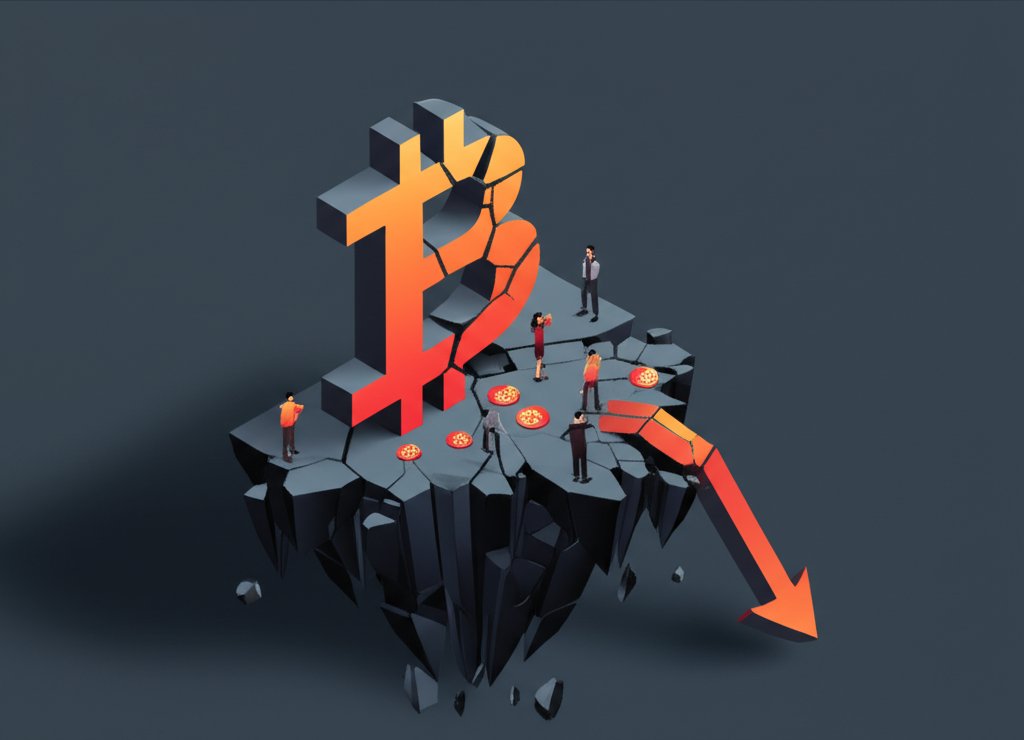
The world of digital assets rarely experiences a quiet day, but few have been as earth-shattering as the one that saw over $19 billion in crypto positions — including more than $5.3 billion in Bitcoin — wiped out in a single, brutal cascade. The trigger? A shock announcement from then-US President Donald Trump: 100% tariffs on all imports from China, particularly rare earth materials critical for advanced technology. This wasn't just a market blip; it was the largest digital asset liquidation event in history, a stark reminder of crypto's interconnectedness with global geopolitics and the raw power of leverage.
At a Glance: What You Need to Know About Bitcoin Liquidations

- Sudden Shock: A geopolitical event (Trump's tariff announcement) triggered a massive cryptocurrency market crash.
- Billions Wiped: Over $19 billion in leveraged digital asset positions, including $5.3 billion in Bitcoin, were forcibly closed.
- Massive Scale: 1.6 million traders were liquidated in 24 hours as Bitcoin's price plummeted from over $125,000 to $106,000.
- What is Liquidation? It's the automatic forced closure of a leveraged trading position when a trader's margin account can no longer cover their losses.
- Leverage is a Double-Edged Sword: While it amplifies gains, it exponentially increases risk, making traders vulnerable to sudden market shifts.
- Macro Matters: The event underscored how global economic and political news can profoundly impact crypto markets, just like traditional assets.
- Risk Management is Key: Understanding leverage, setting stop-losses, and avoiding over-exposure are crucial for surviving volatile periods.
The Day the Markets Held Their Breath: A $19 Billion Shockwave
Imagine the market humming along, Bitcoin hitting new record highs, traders feeling invincible with their leveraged positions. Then, a presidential tweet. Or perhaps, a formal announcement that hits the wires like a lightning bolt. When President Trump declared a 100% tariff on all Chinese imports, citing restrictions on rare earth materials, the financial world braced itself. But no one anticipated the sheer magnitude of the crypto carnage that would follow.
This wasn't a minor tremor. It was an earthquake that reverberated across every corner of the digital asset landscape. In a span of just 24 hours, over 1.6 million traders saw their positions forcibly closed. The total value of these liquidations soared past an astonishing $19.13 billion, with Bitcoin alone accounting for over $5.3 billion of that figure. These weren't just numbers; they represented shattered portfolios, immense stress, and a brutal lesson in market volatility.
Bitcoin, which had been basking in the glow of a record high above $125,000, free-fell to as low as $106,000 before finding some footing around $112,000, marking an 8% drop on the day. The broader digital asset market capitalization shrank by a staggering $560 billion, plummeting from $4.3 trillion to $3.74 trillion, all while trading volumes exploded past $500 billion. It was a clear demonstration of how quickly fortunes can turn, especially when high-stakes leverage is involved.
What Exactly is Bitcoin Liquidation? (And Why it Matters to You)
At its core, a bitcoin liquidation is the forced closing of a trader's leveraged position by an exchange. Think of it like a safety mechanism, albeit a painful one, designed to prevent a trader's losses from spiraling out of control and to protect the exchange from potential bad debt.
Here's how it typically unfolds: when you trade with leverage, you're essentially borrowing funds from an exchange to amplify your potential returns. However, this also magnifies your potential losses. If the market moves against your position, your collateral (known as margin) starts to diminish. If your losses eat into your margin to a point where it falls below a certain threshold – the "maintenance margin" – the exchange will issue a "margin call." This is a request for you to deposit more funds to shore up your position. If you fail to do so, or if the market moves too quickly for you to react, the exchange automatically steps in. It forcibly closes your position at the current market price to cover the losses and prevent your account from going into negative equity. This forced closure is the liquidation.
For many in the crypto community, being liquidated is colloquially known as getting "rekt," a slang term derived from "wrecked." It vividly describes the significant financial setback and the often brutal speed at which these events can unfold. It's a professional way of saying you suffered a major financial loss on a leveraged trade. Learning to anticipate and, more importantly, mitigate the risk of these events is critical for anyone venturing into leveraged trading. To dive deeper into the nuts and bolts of how these mechanisms work, it’s worth spending time Understanding BTC liquidations.
The Mechanics Behind the Mayhem: Leverage and Margin
To truly grasp the impact of a bitcoin liquidation event, you need to understand the twin pillars of leveraged trading: leverage itself and margin.
Leverage: The Double-Edged Sword
Leverage allows traders to open positions significantly larger than their initial capital. For example, with 10x leverage, a $1,000 investment allows you to control a $10,000 position. This is fantastic when the market moves in your favor, as your profits are calculated on the full $10,000. A 1% price increase on a $10,000 position yields $100, which is a 10% return on your initial $1,000.
However, leverage works both ways. If the market moves against your position, a 1% price decrease on that same $10,000 position means a $100 loss. That's still a 10% loss on your initial $1,000. The higher the leverage, the smaller the price movement required to wipe out your initial capital. If you use 100x leverage on that same $1,000, a mere 1% drop in the asset's price means a $1,000 loss – your entire initial capital gone.
Margin: The Collateral Cushion
Your "margin" is the capital you initially deposit with the exchange to open and maintain your leveraged position. It acts as collateral. When you open a leveraged trade, a portion of your margin is "initial margin" – the minimum required to open the position. As the trade progresses, your account must maintain a "maintenance margin" level. This is a percentage of the total position value that you must hold in your account to keep the trade open.
Here’s a simplified scenario:
You put up $1,000 as margin and open a $10,000 Bitcoin long position (10x leverage).
Bitcoin's price drops. Your $10,000 position is now worth $9,800 (a 2% drop).
Your initial $1,000 margin has now absorbed $200 in losses, leaving you with $800.
If the exchange's maintenance margin requirement dictates that you need, say, $900 to keep the position open, you're now below that threshold. The exchange will likely send a margin call. If Bitcoin drops further or you don't add more funds, your position gets liquidated. The exchange sells your Bitcoin at market price to recover the borrowed funds, and your remaining $800 (or whatever is left after fees and losses) is all you get back.
This forced closure prevents you from owing the exchange money beyond your initial collateral. During the Trump tariff event, an estimated $16.7 billion of the $19 billion liquidations were "long" positions – traders betting Bitcoin's price would go up. When the price sharply reversed, these longs were obliterated.
Spotting the Telltale Signs: How to Anticipate Liquidation Events
While no crystal ball can predict the exact timing of a market shock, certain indicators and global events can signal increased risk of liquidation cascades. Seasoned traders aren't just watching chart patterns; they're keenly aware of the broader economic and political landscape.
- High Leverage Ratios: When funding rates on perpetual futures contracts are high, it often indicates an abundance of leveraged long positions in the market. This creates a "long squeeze" scenario, where a relatively small price drop can trigger a chain reaction of liquidations. Exchanges and data providers often publish aggregate leverage ratios.
- Significant Macroeconomic News: As the Trump tariff shock clearly demonstrated, major geopolitical or economic announcements can send ripples (or tsunamis) through all financial markets, including crypto. Keep an eye on:
- Interest Rate Decisions: Central bank actions significantly impact liquidity and investor sentiment.
- Inflation Reports: Unexpected inflation can lead to risk-off sentiment.
- Geopolitical Tensions: Trade wars, sanctions, or conflicts create uncertainty.
- Regulatory Announcements: New rules or bans on crypto can cause sharp corrections.
- Large Price Deviations from Fair Value (Funding Rates): In perpetual futures markets, funding rates are periodic payments made between traders holding long and short positions. Positive funding rates mean longs pay shorts, indicating bullish sentiment and potentially over-leveraged long positions. Extremely positive (or negative) funding rates can signal an impending correction or squeeze.
- Low Trading Volume Coupled with High Open Interest: If there's a lot of open interest (total number of outstanding contracts) in leveraged derivatives but low spot market trading volume, it suggests a market ripe for manipulation or sharp movements with less liquidity to absorb them.
- Technical Indicators & Key Support/Resistance Levels: For technical analysts, a break below crucial support levels can accelerate selling pressure, triggering stop-losses and, subsequently, liquidations.
No single indicator is foolproof, but a confluence of these factors should prompt traders to review their leverage, adjust stop-loss orders, and potentially de-risk their positions.
Beyond Bitcoin: Why Altcoins Plummeted Even Harder
While Bitcoin bore the brunt of the dollar value in liquidations, altcoins — cryptocurrencies other than Bitcoin — experienced a far more brutal percentage drop during the tariff shock. Some altcoins lost 50-60% of their value, a testament to their inherent volatility and market dynamics.
Several factors contribute to altcoins' heightened sensitivity during market downturns:
- Lower Liquidity: Altcoins generally have smaller market capitalizations and lower trading volumes compared to Bitcoin. This means that a relatively smaller sell-off can have a disproportionately larger impact on their prices. When a market panic ensues, there simply aren't enough buyers to absorb the selling pressure.
- Higher Beta: In traditional finance, "beta" measures an asset's volatility relative to the overall market. Many altcoins have a higher beta than Bitcoin, meaning they tend to amplify Bitcoin's movements. If Bitcoin drops 10%, a high-beta altcoin might drop 20% or more.
- "Flight to Quality": During periods of extreme uncertainty and fear, investors typically flock to assets perceived as safer. In the crypto space, Bitcoin is often seen as the "gold standard" and a relatively safer bet compared to newer, less established altcoins. This "flight to quality" often means selling altcoins to either hold stablecoins or re-allocate to Bitcoin, exacerbating altcoin price declines.
- Leverage Amplification: Just like Bitcoin, many altcoins can be traded with leverage. However, given their higher volatility, leveraged altcoin positions are even more precarious. A small market correction can rapidly lead to massive liquidations across the altcoin board, triggering further downward spirals.
The $19 billion liquidation event highlighted this tiered risk profile vividly. While Bitcoin suffered, the altcoin market was absolutely decimated, leaving many traders with significantly reduced portfolios or entirely wiped-out positions.
The Unseen Hand: Bitcoin's Ties to the Global Economy
For years, a popular narrative positioned Bitcoin and other cryptocurrencies as entirely uncorrelated assets, a safe haven independent of traditional financial markets. The Trump tariff shock decisively challenged this idea. As digital assets spiraled, so too did global stocks and oil prices. Simultaneously, investors rushed into traditional safe havens like gold and U.S. Treasuries. This wasn't a coincidence; it was a clear demonstration of Bitcoin's growing entanglement with the global macroeconomy.
When significant geopolitical or economic events unfold, capital flows shift dramatically. Investors reassess risk, and during times of uncertainty, the instinct is to shed perceived riskier assets. While crypto markets might operate 24/7 without traditional banking hours, they are not immune to the collective sentiment and capital movements of global investors. Large institutional players, increasingly involved in crypto, often manage diversified portfolios where crypto assets are just one component. When faced with systemic risk, they tend to de-risk across the board.
This event, along with others since, solidifies the argument that Bitcoin and other digital assets are increasingly sensitive to:
- Global Interest Rates: Higher rates make traditional assets more attractive and borrowing more expensive, potentially drawing capital away from speculative assets like crypto.
- Inflation and Economic Growth Data: These metrics influence central bank policies and overall investor confidence.
- Geopolitical Stability: Major conflicts or trade wars create uncertainty, pushing investors towards perceived safety.
- Regulatory Environments: Government stances on crypto can create significant market shifts.
Ignoring these macroeconomic signals would be a grave mistake for any serious crypto investor or trader. The market is maturing, and with that maturity comes greater integration into the broader financial ecosystem. For those looking to deepen their strategic understanding of market movements, Understanding BTC liquidations offers valuable insights into the ripple effects of macro events.
The Contrarian Bet: One Trader's $190 Million Coup
Amidst the chaos and widespread losses, one story emerged that painted a stark contrast to the general devastation: that of an individual who reportedly amassed a staggering $190 million profit. How? By opening massive short positions on both Bitcoin and Ethereum just moments before Trump's tariff announcement.
This wasn't luck; it was a high-stakes, incredibly well-timed, and likely well-informed, contrarian bet.
What is Shorting?
Shorting, or "going short," is the opposite of going long. Instead of betting that an asset's price will rise, you're betting it will fall. Here's the basic idea:
- Borrow: You borrow an asset (e.g., Bitcoin) from your broker or exchange.
- Sell: You immediately sell the borrowed Bitcoin at its current market price.
- Buy Back: If the price falls as you predicted, you buy back the same amount of Bitcoin at the lower price.
- Return: You return the borrowed Bitcoin to your broker.
- Profit: The difference between your initial selling price and your lower buying-back price (minus fees) is your profit.
In this case, the trader seemingly had intelligence or an incredibly acute read on the market's vulnerability to such an announcement. They borrowed large amounts of BTC and ETH, sold them, and then watched as the prices plummeted following the news. They then bought back the crypto at significantly lower prices, returned the borrowed assets, and pocketed the difference – a cool $190 million.
This anecdote highlights a few critical points:
- Information Edge: In volatile markets, timely information can be immensely powerful.
- Risk Tolerance: Shorting is inherently risky. If the market had moved against this trader, their losses would have been amplified, potentially leading to their own liquidation.
- Market Dynamics: While most traders were caught off guard with long positions, the market provides opportunities for those who can predict or react quickly to downward movements.
It's a testament to the immense opportunities (and immense risks) present in highly leveraged markets, especially during periods of extreme volatility.
Navigating the Volatile Waters: Lessons from the $19 Billion Shake-Up
The Trump tariff-induced liquidation cascade was a brutal, expensive lesson for over a million traders. But every crisis offers valuable insights. For those looking to survive and even thrive in crypto's inherently volatile landscape, learning from such events is paramount.
Pitfalls to Avoid:
- Over-Leveraging: This is the most common culprit behind mass liquidations. While tempting, excessive leverage (e.g., 50x or 100x) leaves almost no room for error. A small market fluctuation can quickly wipe out your entire margin. Always remember that higher leverage equals higher risk.
- Ignoring Macro Signals: The idea that crypto is entirely decoupled from the global economy is a dangerous myth. Geopolitical events, interest rate decisions, inflation data, and regulatory shifts can all trigger significant market movements. Don't trade in a vacuum.
- Trading Without a Stop-Loss: A stop-loss order is your best friend in leveraged trading. It automatically closes your position if the price hits a pre-defined level, limiting your potential losses. Failing to use them, especially in highly volatile markets, is akin to driving without brakes.
- Chasing Pumps: Jumping into a rapidly rising asset, often with leverage, at its peak is a recipe for disaster. These "FOMO" (Fear Of Missing Out) trades are often the first to be liquidated during a correction.
- Insufficient Margin: Keeping just the bare minimum maintenance margin is risky. A sudden price swing might not give you enough time to add more funds, leading to instant liquidation.
Best Practices for Traders:
- Understand Your Risk Tolerance: Before you even consider leverage, honestly assess how much you're willing to lose. Only allocate capital you can afford to completely forfeit.
- Start Small, Learn Gradually: Don't jump into high-leverage trading with significant capital. Begin with small amounts, low leverage, and gradually increase as you gain experience and confidence.
- Always Use Stop-Loss Orders: This cannot be stressed enough. Define your maximum acceptable loss per trade and stick to it.
- Monitor Your Margin Levels Closely: Be aware of your liquidation price and the amount of margin you have. Have extra funds ready to deposit if a margin call is issued, or be prepared to close positions manually if needed.
- Diversify Your Portfolio (Carefully): While not foolproof, spreading your capital across different assets can reduce the impact of a single asset's downturn. However, remember that during severe market crashes, most assets tend to fall together.
- Stay Informed: Follow reputable financial news sources. Understand the broader economic narrative. Major news can precede major market movements.
- Consider Lower Leverage: While 100x leverage sounds exciting, 2x or 3x leverage can still amplify returns while providing a much larger buffer against volatility.
- Practice Risk Management: This includes position sizing (how much capital to allocate to a trade), stop-loss placement, and taking profits at predetermined targets. Developing robust risk management skills is essential for long-term success, and it's a key area that can be fortified by Understanding BTC liquidations in depth.
Your Questions Answered: Common Liquidation FAQs
Navigating the complexities of leveraged trading and liquidation can bring up many questions. Here are some common ones, answered concisely.
Can I prevent liquidation?
Yes, to a degree. You can prevent liquidation by managing your risk effectively. This includes:
- Using lower leverage.
- Placing stop-loss orders.
- Maintaining sufficient margin in your account (don't let it dip too close to the maintenance margin).
- Actively monitoring your positions and the market, and being prepared to manually close a position if it's going significantly against you.
- Responding to margin calls by adding more collateral.
What happens to my funds after liquidation?
When your position is liquidated, the exchange forcibly closes it at the current market price. Any remaining balance in your margin account, after covering the losses and any liquidation fees, will be returned to your spot wallet or remain in your derivatives account. However, your initial margin used for the liquidated trade will likely be significantly reduced or entirely lost, depending on the severity of the price movement.
Is liquidation always bad?
For the trader experiencing it, yes, it's always a negative event as it results in significant financial loss. However, from a broader market perspective, liquidation cascades can serve a function:
- Market Reset: They can flush out excessive leverage, potentially leading to a healthier, less speculative market environment in the short term.
- Opportunity for Others: For contrarian traders (like the short seller mentioned earlier) or those waiting to buy at lower prices, liquidations can present lucrative opportunities.
- Price Discovery: While painful, liquidations contribute to rapid price discovery during times of high volatility.
How quickly can liquidation occur?
Liquidation can occur almost instantaneously, especially during flash crashes or periods of extreme volatility. Market prices can move so rapidly that the system triggers a liquidation before a human trader even has a chance to react or deposit more funds. This is why having pre-set stop-loss orders is so critical.
Do all crypto exchanges handle liquidation the same way?
While the core principle of forced closure due to insufficient margin is universal, the exact parameters can vary between exchanges. This includes:
- Leverage offerings: Different maximum leverage.
- Margin requirements: Different initial and maintenance margin percentages.
- Liquidation engines: Different algorithms and processes for closing positions.
- Liquidation fees: Some exchanges may charge an additional fee for liquidations.
Always read the terms and conditions of your chosen exchange regarding leveraged trading and liquidation.
Building Resilience: A Smarter Approach to Crypto Investing
The echoes of the $19 billion liquidation event serve as a powerful reminder: the crypto market is a force of nature, capable of both immense opportunity and brutal corrections. The narrative of an isolated, uncorrelated asset class has been largely debunked by these macro-driven events. To navigate this landscape successfully, a paradigm shift is necessary from chasing quick gains to adopting a disciplined, long-term, and risk-aware approach.
Instead of viewing volatility as a bug, see it as an inherent feature of this nascent asset class. Develop a robust risk management strategy that prioritizes capital preservation above all else. Educate yourself not just on the technical intricacies of blockchain, but also on global economics, geopolitics, and market psychology. The traders who thrive are not necessarily the ones who make the most aggressive bets, but those who understand the forces at play and prepare for every eventuality.
Build resilience into your portfolio by:
- Prioritizing fundamental analysis: Understand the projects you're investing in.
- Practicing smart position sizing: Never bet more than you can comfortably lose.
- Utilizing conservative leverage (or none at all): Especially when you're starting out.
- Having a clear investment thesis: Know why you're holding an asset.
- Exercising patience: Rome wasn't built in a day, and generational wealth isn't typically built on a single, high-leverage trade.
The crypto market is evolving, and so must its participants. By embracing education, discipline, and a healthy respect for market forces, you can transform these cautionary tales into valuable lessons, equipping yourself to build a more secure and sustainable future in the world of digital assets.